

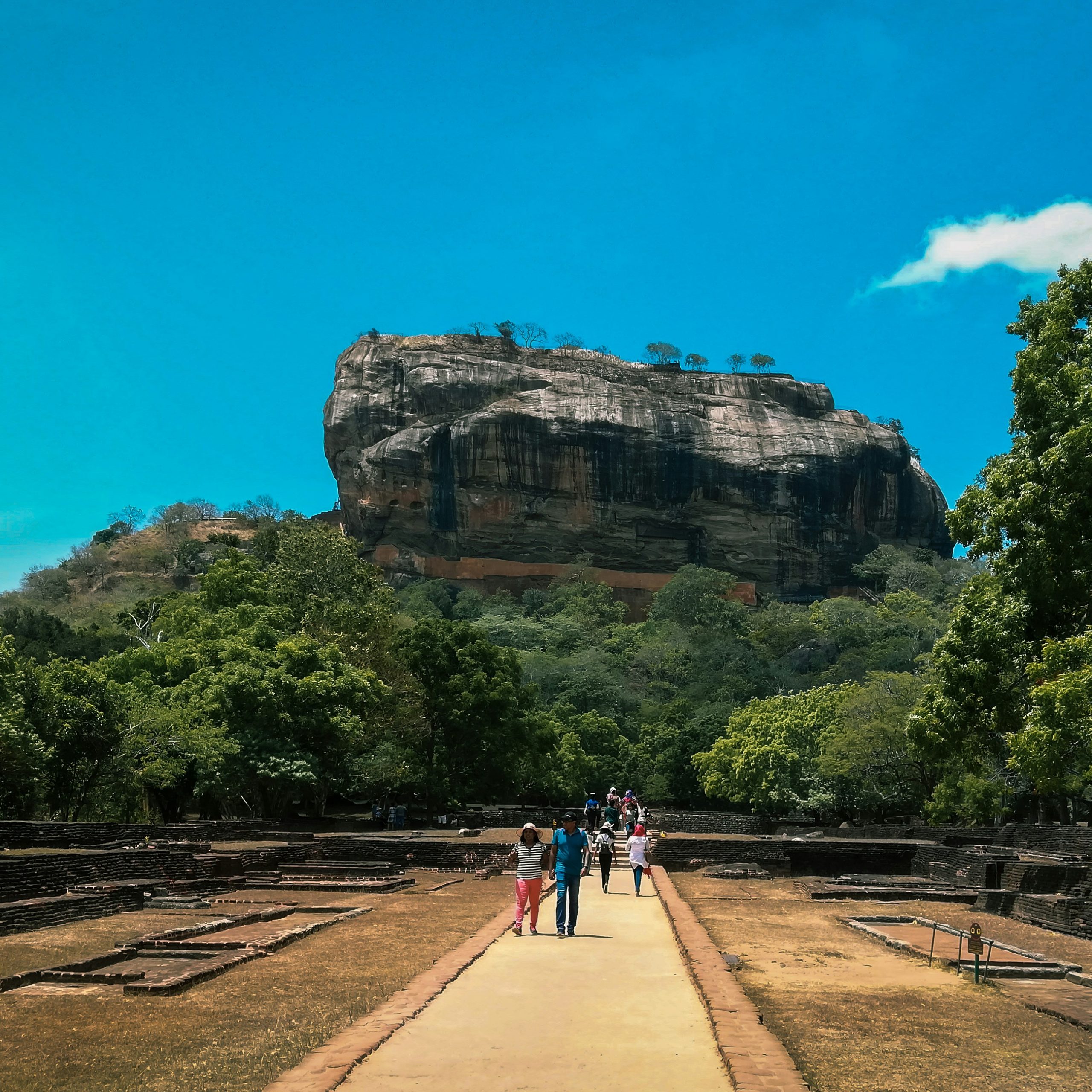
Sigiriya or Sinhagiri (Lion Rock Sinhala: සීගිරිය, Tamil: சிகிரியா/சிங்ககிரி, /ˈsiːɡɪrɪjə/) is an ancient rock fortress located in the northern Matale District near the town of Dambulla in the Central Province, Sri Lanka. It is a site of historical and archaeological significance that is dominated by a massive column of granite approximately 180 m (590 ft) high.[2]
According to the ancient Sri Lankan chronicle the Cūḷavaṃsa, this area was a large forest, then after storms and landslides it became a hill and was selected by King Kashyapa (CE 477–495) for his new capital. He built his palace on top of this rock and decorated its sides with colourful frescoes. On a small plateau about halfway up the side of this rock he built a gateway in the form of an enormous lion. The name of this place is derived from this structure; Sinhagiri, the Lion Rock.
The capital and the royal palace were abandoned after the king’s death. It was used as a Buddhist monastery until the 14th century.[3] Sigiriya today is a UNESCO listed World Heritage Site. It is one of the best preserved examples of ancient urban planning
History
It is likely that the area around Sigiriya was inhabited since prehistoric times. There is clear evidence from Brahmi inscriptions on the western side of Sigiriya that the many rock shelters and caves in the vicinity were occupied by Buddhist monks and ascetics from as early as the 1st or 2nd century BCE.[7] The earliest evidence of human habitation at Sigiriya is the Aligala rock shelter to the east of Sigiriya rock, indicating that the area was occupied circa 3000 BCE during the Mesolithic Period.[8]
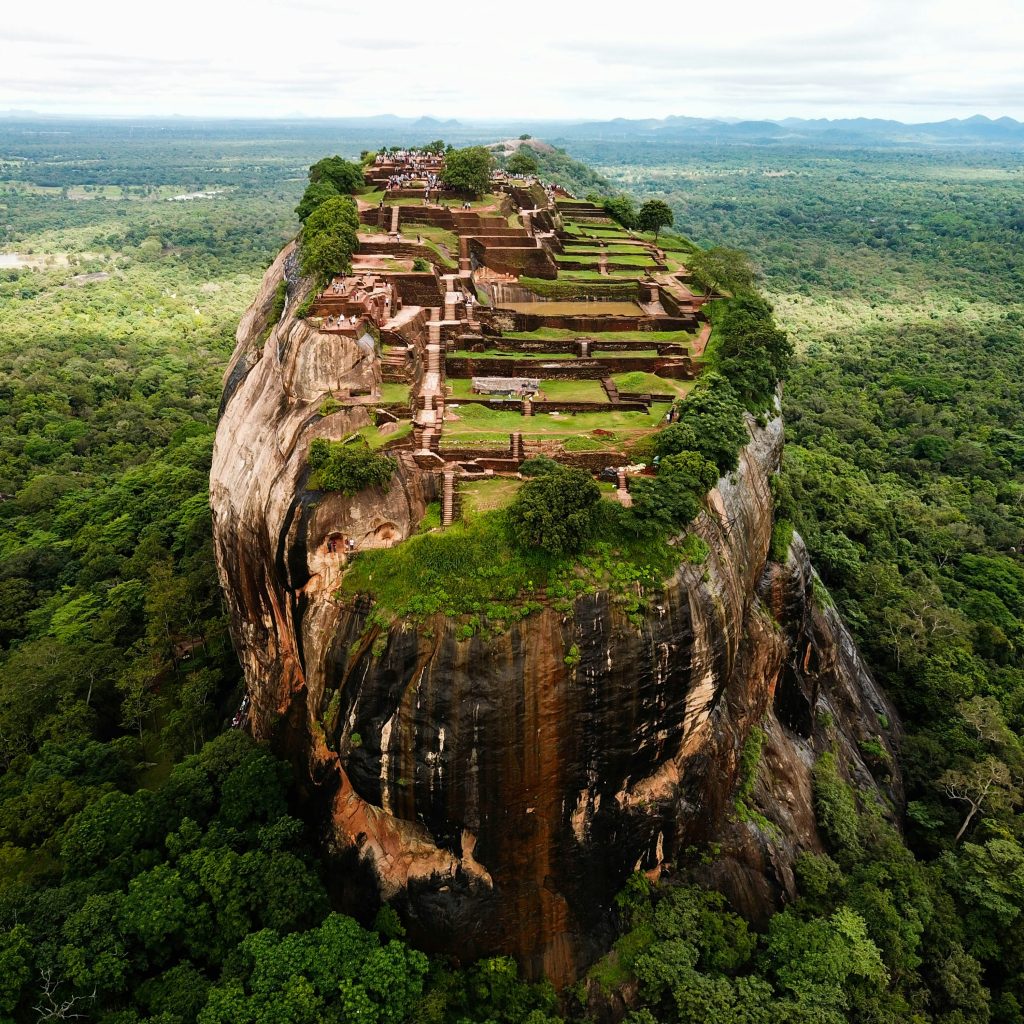
Aerial view of Sigiriya Rock
Map of Sigirya archaeological site.
Buddhist monastic settlements were established during the 3rd century BCE in the western and northern slopes of the boulder-strewn hills surrounding the Sigiriya rock. Several rock shelters or caves were created during this period. These shelters were made under large boulders, with carved drip ledges around the cave mouths. Rock inscriptions are carved near the drip ledges on many of the shelters, recording the donation of the shelters to the Buddhist monastic order as residences. These were made in the period between the 3rd century BCE and the 1st century CE.
The Cūḷavaṃsa describes that in 477 CE, Kashyapa I, the son of King Dhatusena by a non-royal consort, seized the throne in a coup assisted by Migara, the King’s nephew and army commander. He murdered his father by walling him up alive and then usurped the throne which rightfully belonged to his half-brother Moggallana who, fearing for his life, fled to South India, but vowed revenge.[3][4]
Expecting the inevitable return of Moggallana, Kashyapa moved the capital and his residence from the traditional capital of Anuradhapura to the more secure summit of Sigiriya. During King Kashyapa’s reign (477–495 CE), Sigiriya was developed into a complex city and fortress.[3][4] Most of the elaborate constructions on the rock summit and around it, including defensive structures, palaces, and gardens, date from this period.[citation needed]
When Moggallana finally arrived, he declared war, and defeated Kashyapa in 495 CE. During the battle Kashyapa’s armies abandoned him and he committed suicide by falling on his sword.[3][4]
The Cūḷavaṃsa and folklore inform us that the war elephant on which Kashyapa was mounted changed course to take a strategic advantage, but the army misinterpreted the movement as the king’s having opted to retreat, prompting the army to abandon him altogether. It is said that being too proud to surrender he took his dagger from his waistband, cut his throat, raised the dagger proudly, sheathed it, and fell dead. Moggallana returned the capital to Anuradhapura, converting Sigiriya into a Buddhist monastery complex,[9] which survived until the 13th or 14th century. After this period, no records are found on Sigiriya until the 16th and 17th centuries, when it was used briefly as an outpost of the Kingdom of Kandy.


Comment (0)